

Why Rich People Love Inflation (While Most People Fear It)
- Aboubacar Moussa Konate

- Jul 12
- 32 min read
Introduction
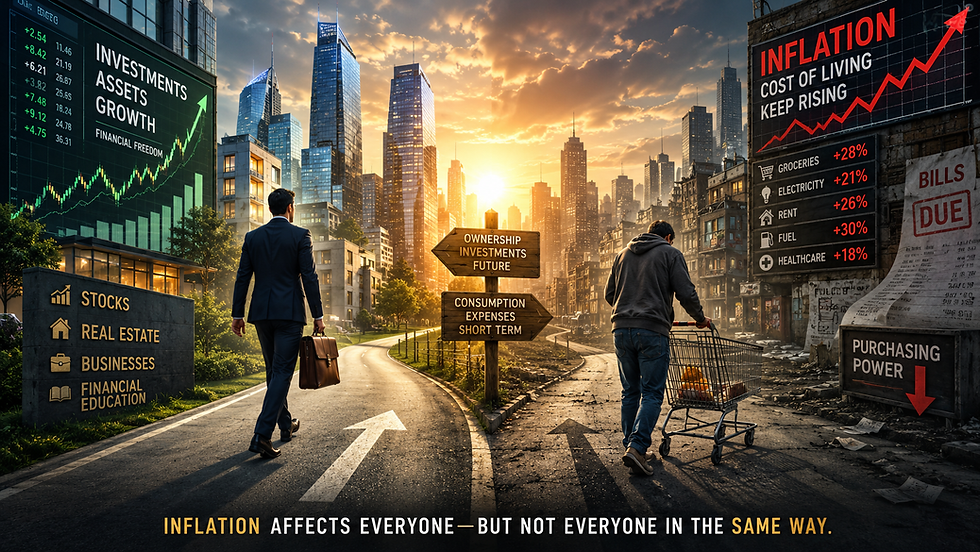
Inflation is one of the most talked-about economic topics in the world. Every time prices rise, headlines warn about the cost of living, shrinking purchasing power, and the pressure on household budgets. Families notice it at the grocery store. Drivers notice it at the gas station. Businesses notice it when paying suppliers. Almost everyone experiences inflation in one way or another.
Because of this, most people naturally see inflation as the enemy. Higher prices seem to mean a lower standard of living, less financial security, and fewer opportunities to save for the future. It is therefore easy to conclude that inflation hurts everyone equally.
But does it?
History suggests a more complex reality.
While many households struggle during periods of rising prices, some individuals, businesses, and investors continue to expand their wealth. In some cases, they become significantly wealthier than before. This raises an important question: if inflation is supposed to make everyone poorer, why do some of the world's wealthiest individuals and companies continue to thrive during inflationary periods?
The answer is not that they enjoy paying higher prices. They don't.
The difference lies in how they own assets, manage debt, generate income, and position themselves within the economy. Inflation affects every dollar, euro, or pound in circulation, but it does not affect every financial strategy in the same way. Some assets lose value in real terms. Others become more valuable. Some sources of income struggle to keep pace with inflation, while others naturally adjust as prices rise.
Understanding this distinction can completely change the way you think about money.
This article is not about glorifying inflation or suggesting that rising prices are good for society. Inflation creates real challenges for millions of people and can significantly reduce living standards when it becomes excessive. Instead, this article explores why inflation often widens the gap between those who understand how wealth is created and those who rely primarily on earned income and cash savings.
By the end, you will understand why inflation creates both winners and losers, why many wealthy investors view it differently from most people, and, most importantly, how you can make better financial decisions regardless of the economic environment.

Key Takeaways
Inflation affects everyone, but it does not affect everyone in the same way. While most people focus on rising prices, financially educated investors pay closer attention to purchasing power, productive assets, debt, and long-term wealth creation. Throughout this article, you will discover why inflation often benefits those who own businesses, stocks, real estate, or other appreciating assets, while reducing the value of idle cash and fixed-income savings. You will also learn how governments, central banks, businesses, and consumers respond to inflation, why understanding these dynamics matters, and how adopting an investor's mindset can help you protect—and potentially grow—your wealth during inflationary periods. Knowledge, not inflation itself, often determines who wins and who falls behind.
Chapter 1 — What Inflation Really Is
Inflation is one of the most misunderstood concepts in economics. Ask ten people to define it, and many will simply say, "It means prices are going up." While that is true, it only describes the symptom—not the underlying phenomenon.
At its core, inflation is the gradual decline in the purchasing power of money. In simple terms, the same amount of money buys fewer goods and services than it did before.

It is not that money disappears from your wallet. Instead, each dollar, euro, or pound quietly loses part of its buying power over time.
Imagine you have $100 today. If annual inflation is 5%, that same $100 will buy roughly 5% fewer goods and services a year from now, assuming your income and investments do not increase at the same pace. You still have the same amount of money, but it is worth less in real terms.
This is why economists distinguish between nominal value and real value. The nominal value is the number printed on your bank account or paycheck. The real value is what that money can actually buy. Inflation affects the second one, and over time, the difference can become substantial.
But why does inflation happen?
One common reason is demand-pull inflation. This occurs when consumers want to buy more goods and services than businesses can produce. Strong demand pushes prices higher because supply cannot keep up.
Another cause is cost-push inflation. When businesses face higher production costs—such as rising wages, energy prices, transportation expenses, or raw material costs—they often pass part of those increases on to customers through higher prices.
There is also the role of the money supply. When more money circulates throughout an economy without a corresponding increase in the production of goods and services, each unit of currency may gradually lose value. While money creation alone does not automatically cause inflation, excessive growth in the money supply can contribute to rising prices under certain economic conditions.
To monitor inflation, many countries use the Consumer Price Index (CPI). The CPI measures the average price changes of a basket of commonly purchased goods and services, including food, housing, transportation, healthcare, and education. Although no single index perfectly reflects every household's experience, it provides a useful benchmark for tracking inflation over time.
Interestingly, central banks do not usually aim for zero inflation. Institutions such as the European Central Bank and the Federal Reserve generally target low and stable inflation because they believe modest price growth encourages spending, investment, and economic activity while reducing the risk of prolonged deflation.
However, there is an important difference between healthy inflation and high inflation. Moderate inflation can support economic growth by encouraging investment and consumption. Excessive inflation, on the other hand, erodes purchasing power, creates uncertainty, distorts financial planning, and can damage long-term economic stability.
Understanding inflation requires looking beyond rising prices. Inflation is ultimately about the changing value of money itself. Every financial decision—saving, investing, borrowing, or spending—is influenced by this invisible force. Those who recognize how inflation works are better equipped to protect their purchasing power and make smarter long-term financial decisions.
As you will discover throughout this article, inflation does not simply change prices. It changes the way wealth is created, preserved, and transferred across society.
Chapter 2 — Why Most People Fear Inflation
For most people, inflation is not an economic theory. It is a daily experience.
They see it every time they buy groceries, fill up their car, pay their rent, renew an insurance policy, or receive an electricity bill. The numbers may seem small at first—a few cents here, a few dollars there—but over time they accumulate into a significant financial burden.
This is why inflation is often called the "silent tax." Unlike an official tax increase, inflation does not arrive with a letter from the government. Instead, it quietly reduces the purchasing power of your income without asking for permission.
Imagine receiving a 3% salary increase at the beginning of the year. At first, it feels like good news. But if inflation reaches 6% during the same period, your purchasing power has actually fallen. Although your paycheck is larger in nominal terms, it buys fewer goods and services than before. In real terms, you have become poorer.
This explains why so many people feel frustrated during periods of inflation. They may be working just as hard—or even harder—yet they struggle to maintain the same standard of living.

Inflation affects everyone differently. While rising prices reduce purchasing power for many households, those who own productive assets, businesses, or inflation-resistant investments may actually benefit. Understanding the difference is the first step toward making better financial decisions.
The impact is especially visible in essential expenses.
Food prices often rise first because agricultural production, transportation, packaging, and energy costs all increase. Housing becomes more expensive as construction materials, maintenance costs, insurance, and financing costs rise. Fuel prices affect almost every industry because goods must be transported before they reach consumers. Healthcare, education, and childcare also become more expensive, placing additional pressure on household budgets.
For many families, these are not optional expenses. They cannot simply stop eating, paying rent, or commuting to work. As a result, inflation forces them to make difficult choices elsewhere. Vacations are postponed. Savings contributions are reduced. Home improvements are delayed. Retirement planning becomes less certain.
Inflation also creates psychological stress.
People begin to worry that their money is losing value faster than they can earn it. They become more cautious about spending, more anxious about the future, and more sensitive to every price increase they encounter. Even when inflation eventually slows, those habits of uncertainty often remain.
This fear is reinforced because most people rely primarily on earned income. Their financial security depends on a salary that is adjusted only occasionally, if at all. Prices, however, can change much more quickly than wages. When that happens, inflation creates a growing gap between income and expenses.
Another reason inflation feels so painful is that it is highly visible. Consumers notice when the price of bread doubles or when fuel becomes significantly more expensive. They rarely notice the hidden opportunities that inflation may create in financial markets, businesses, or real assets. As a result, inflation is often viewed only through the lens of higher costs rather than changing opportunities.
This difference in perspective is critical.
Most people experience inflation as rising prices because they spend most of their time as consumers.
Investors, entrepreneurs, and business owners often experience the same inflation from a different angle. While they are also consumers, they spend much of their time thinking about ownership, pricing power, investments, and long-term asset growth.
That difference in perspective is where the story of inflation truly begins. The next chapter explores why one of the safest places many people believe they have for their money—cash savings—may actually become one of the weakest during periods of inflation.
Chapter 3 — Why Inflation Hurts Cash Savers
For generations, people have been taught that saving money is the foundation of financial security. Parents encourage their children to save. Financial advisors recommend building an emergency fund. Banks promote savings accounts as a safe place to keep money. All of this is sound advice.
However, there is one important detail that many people overlook.
Saving money and preserving wealth are not always the same thing.
Cash provides safety, liquidity, and peace of mind. It allows you to pay unexpected expenses, avoid unnecessary debt, and take advantage of opportunities when they arise. But during periods of inflation, cash has one major weakness: it does not automatically grow with the rising cost of living.
Imagine that you place $100,000 in a savings account earning 1% interest per year. At first glance, your wealth appears to be increasing. One year later, your account balance has grown to $101,000.
Now imagine that inflation during the same year is 5%.
Although your account statement shows more money, your purchasing power has actually declined. The goods and services that cost $100,000 one year ago now cost approximately $105,000. In real terms, you have lost buying power despite having earned interest.
This illustrates one of the most important concepts in personal finance: the difference between nominal returns and real returns.
A nominal return is the percentage your investment or savings earns before accounting for inflation.
A real return measures how much your purchasing power actually increases after inflation has been taken into account.
If your savings earn 2% while inflation is 5%, your real return is negative. Your money is growing on paper but shrinking in purchasing power.
This is why inflation quietly punishes people who hold large amounts of idle cash for long periods.

The effect may seem small over one year, but over decades it becomes dramatic.
Suppose inflation averages just 3% annually. At that rate, the purchasing power of money is roughly cut in half over about twenty-four years. In other words, what $100 can buy today may require nearly $200 in the future.
This explains why simply accumulating cash is rarely enough to build long-term wealth.
Cash is designed for stability, not growth.
It is an excellent tool for paying bills, handling emergencies, and maintaining financial flexibility. But it was never intended to be a long-term wealth-building asset.
This is why financially educated investors often separate their money into different purposes.
They keep enough cash to cover emergencies and short-term expenses.
The rest is gradually allocated to productive assets that have the potential to grow faster than inflation over time.
It is important to avoid a common misunderstanding.
This does not mean cash is bad.
In fact, every household should maintain an emergency fund because unexpected events can happen at any time. Losing your job, facing a medical emergency, or repairing a damaged home may require immediate access to money. Selling long-term investments during a market downturn simply because you have no cash reserve can be far more costly.
The real lesson is about balance.
Cash protects your liquidity.
Assets protect your purchasing power.
Confusing these two roles is one of the most common financial mistakes people make.
Many individuals proudly say they have kept their savings in the bank for twenty or thirty years because it feels safe. What they often fail to consider is that safety has a cost. While the money remained protected from market volatility, it was continuously exposed to another force that receives far less attention: inflation.
In reality, inflation is not only reducing the value of prices around you.
It is also quietly measuring the cost of standing still.
Those who leave all their wealth in cash gradually watch their purchasing power decline.
Those who understand inflation begin asking a different question.
Instead of asking, "Where can I safely keep my money?"
They ask,
"How can my money continue working while I sleep?"
That single change in thinking marks the transition from being a saver to becoming an investor—and it explains why the wealthy often focus less on accumulating cash and more on owning productive assets that can grow over time.
Chapter 4 — The Hidden Advantage of Asset Owners

If inflation quietly weakens the purchasing power of cash, an obvious question follows.
Where does the money go?
Many people assume inflation simply makes everyone poorer. In reality, inflation often redistributes wealth. Some people lose purchasing power, while others own assets that become more valuable over time.
This is one of the biggest differences between saving money and owning productive assets.
Cash sits.
Assets work.
That distinction may seem simple, but it has created some of the greatest fortunes in history.
Productive assets are things that generate value, income, or both. They do not simply exist; they produce something that people are willing to pay for. Businesses produce goods and services. Stocks represent ownership in companies that earn profits. Real estate provides housing or commercial space. Intellectual property generates royalties. Even farmland can produce crops year after year.
When inflation rises, many of these assets have something that cash does not.
They can adjust.
Imagine you own a bakery.
The price of flour increases.
Electricity becomes more expensive.
Employee wages rise.
If your customers continue buying your products, you may gradually increase the price of bread to reflect your higher costs. Your profits may not remain exactly the same, but your business has the ability to adapt to inflation.
Now imagine that instead of owning the bakery, you simply keep your money in a savings account.
Your cash has no pricing power.
It cannot negotiate.
It cannot produce more value.
It simply waits while inflation slowly reduces what it can buy.
This difference explains why many investors focus on ownership rather than accumulation.
Ownership creates the possibility of growth.
Accumulation alone often creates the illusion of security.
The same principle applies to publicly traded companies.
When well-managed businesses face higher costs, many are able to increase the prices of their products or services. Consumers may pay more for software subscriptions, food, beverages, insurance, healthcare, or transportation. Companies with strong brands, loyal customers, or unique products often have greater pricing power, meaning they can raise prices without losing a significant share of their customers.
This pricing power becomes extremely valuable during inflation.
It allows businesses to protect their revenues and, in many cases, continue growing despite rising costs.
The same logic applies to real estate.
As construction materials, labor, and land become more expensive, the replacement cost of buildings often increases. At the same time, rental income may gradually rise as landlords adjust rents to reflect higher market prices, subject to local laws and lease agreements.
Of course, property values do not rise in a straight line, and local markets can experience significant downturns. Interest rates, economic conditions, and housing supply all influence real estate prices. Nevertheless, over long periods, many real assets have historically provided a degree of protection against inflation because they represent tangible value rather than idle cash.
Intellectual property offers another fascinating example.
A bestselling book.
A successful software application.
A patented invention.
A globally recognized brand.
These assets can continue generating income for years, sometimes decades, without requiring the owner to exchange additional hours of work. Inflation may increase the cost of producing physical goods, but valuable ideas often become even more profitable as demand grows and prices adjust.
Commodities such as gold, energy products, and certain agricultural goods also receive attention during inflationary periods. Investors often view them as potential hedges because their prices may rise when the purchasing power of money falls. However, commodities can also be highly volatile and should not be viewed as guaranteed protection against inflation.
The important lesson is not that every asset always increases in value.
It doesn't.
Stocks fall.
Property markets decline.
Businesses fail.
Commodities fluctuate.
Every investment carries risk.
The real advantage lies elsewhere.
Productive assets have the potential to create new value.
Cash does not.
This is why many wealthy individuals spend less time asking,
"How much money do I have?"
and more time asking,
"What do I own that produces value?"
That shift in thinking changes everything.
Instead of measuring wealth by the size of a bank account, they measure it by the quality of their assets.
A business that generates reliable profits.
A diversified portfolio of productive companies.
A rental property producing steady cash flow.
A patent earning licensing fees.
A digital product sold around the world.
These assets continue working whether their owner is at work, on vacation, or asleep.
This does not mean that becoming wealthy is easy.
Building productive assets requires capital, knowledge, patience, discipline, and the willingness to accept uncertainty. It also requires making mistakes and learning from them.
However, once an asset begins producing value independently, the relationship between time and income starts to change.
That is perhaps the greatest hidden advantage of asset owners.
They gradually move from working primarily for money...
to owning things that increasingly work for them.
Inflation exposes this difference more clearly than almost any other economic force.
While cash quietly loses purchasing power, productive assets often continue creating value, adjusting prices, generating income, and compounding over time.
That is why many financially educated investors pay less attention to the money they hold...
and far more attention to the assets they own.
The question is no longer,
"How much money do I have?"
The more important question becomes,
"What do I own that will still be creating value ten years from now?"
Chapter 5 — Why Debt Can Become a Powerful Tool
For many people, debt is something to avoid at all costs.
Parents teach their children to stay out of debt. Financial experts warn about the dangers of borrowing too much. Stories of bankruptcy, financial stress, and overwhelming credit card balances reinforce the idea that debt is always bad.
But the wealthiest individuals, successful entrepreneurs, and many large corporations often think very differently.
They do not ask,
"How can I avoid debt?"
They ask,
"How can I use debt wisely?"

That single difference in thinking has shaped countless fortunes.
The truth is that debt is neither good nor bad.
Debt is simply a financial tool.
Like any tool, its value depends on how it is used.
Imagine borrowing money to finance an expensive vacation, luxury clothing, or the latest smartphone. Those purchases may bring temporary satisfaction, but they usually lose value over time while the debt remains.
This is an example of consumer debt.
The borrowed money finances consumption rather than future income.
Now imagine borrowing money to purchase an apartment that generates rental income, invest in equipment that increases a company's productivity, or expand a profitable business.
In this case, the debt is helping acquire an asset that has the potential to produce future cash flow.
This is often referred to as productive debt.
The goal is not simply to borrow.
The goal is to own something that earns more than the cost of borrowing over the long term.
Inflation introduces another fascinating dimension to this equation.
Suppose you borrow $400,000 today through a long-term, fixed-rate mortgage.
Your monthly payment is fixed.
Five, ten, or twenty years later, inflation may have increased average salaries, rental income, and property values. Although nothing is guaranteed and markets can move in different directions, the amount you owe to the bank remains fixed in nominal terms.
In other words, you continue repaying the loan with money that may have less purchasing power than when you originally borrowed it.
Meanwhile, if the property has appreciated and rental income has increased over time, the value of the asset may have grown while the real burden of the debt has gradually declined.
This is one reason why many real estate investors pay close attention to inflation.
It is not because they enjoy higher prices.
It is because inflation can gradually change the relationship between the value of an appreciating asset and the fixed amount of debt used to acquire it.
However, this strategy works only under specific conditions.
The asset must generate sufficient income or appreciate over time.
The borrower must be able to make loan payments consistently.
Interest rates, maintenance costs, taxes, vacancies, and market downturns can all affect the outcome.
Debt does not eliminate risk.
It often magnifies it.
This is where many people make a costly mistake.
They see wealthy investors borrowing money and assume that borrowing itself creates wealth.
It doesn't.
Assets create wealth.
Debt simply allows investors to acquire those assets sooner than they otherwise could.
Used wisely, debt can accelerate wealth creation.
Used carelessly, it can accelerate financial destruction.
This is why financially successful people spend more time evaluating the quality of the investment than the size of the loan.
Another important concept is leverage.
Leverage means using borrowed money to increase your potential returns.
Imagine two investors each purchasing a $500,000 commercial property.
One pays entirely in cash.
The other uses a significant down payment and finances the remainder with a long-term loan.
If the property's value increases substantially over time while producing reliable rental income, the leveraged investor may achieve a higher return on the capital personally invested.
Of course, the opposite is also true.
If property values decline sharply or rental income falls, leverage can magnify losses just as quickly as it magnifies gains.
That is why experienced investors respect leverage.
They never assume markets only move upward.
The wealthiest investors rarely think of debt as something emotional.
They think of it mathematically.
They compare the expected return of an asset with the total cost and risk of borrowing.
If the numbers make sense, debt becomes a strategic tool.
If they don't, they walk away.
This disciplined approach explains why two people can borrow the same amount of money and achieve completely different outcomes.
One finances consumption.
The other finances production.
One acquires liabilities.
The other acquires productive assets.
Inflation often widens the gap between these two decisions.
It quietly rewards those who borrowed to own assets capable of creating value while making it increasingly difficult for those who borrowed only to consume.
The lesson is not that everyone should borrow more.
Far from it.
The lesson is that the purpose of debt matters far more than the existence of debt itself.
Debt used to finance consumption often limits future financial freedom.
Debt used carefully to acquire productive assets can, under the right circumstances, become a powerful engine for long-term wealth creation.
Ultimately, the question is not,
"Do you have debt?"
The better question is,
"Is your debt helping build your future… or simply paying for your past?"
Chapter 6 — Businesses Often Pass Inflation to Customers
Imagine running a successful business.
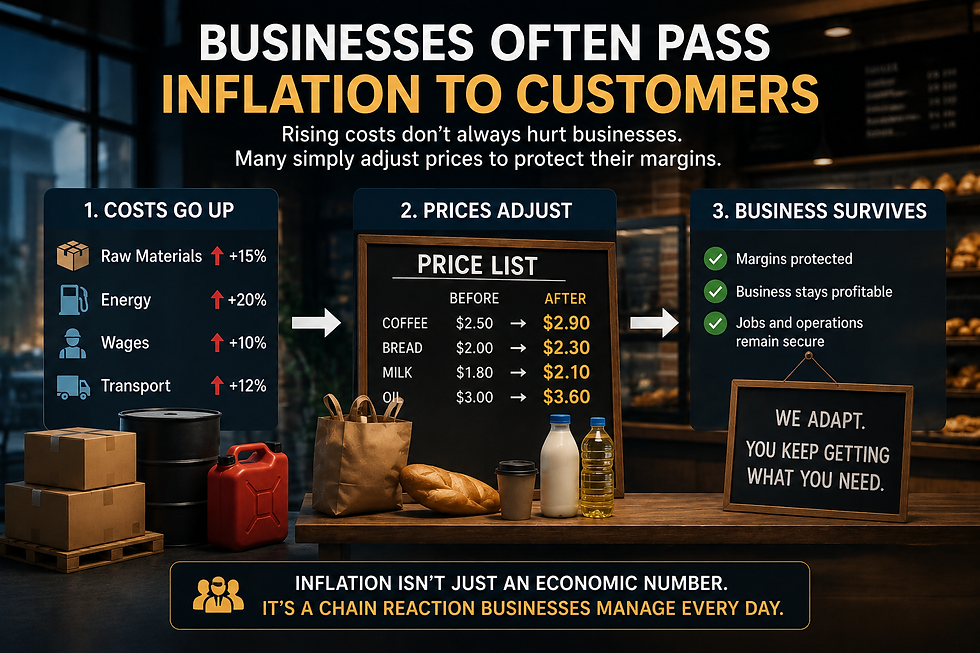
One morning, your suppliers inform you that the price of raw materials has increased by 12%. Electricity costs are rising. Transportation has become more expensive. Employee wages have gone up, and your insurance premiums are higher than last year.
You now face a difficult decision.
Should you absorb these additional costs and accept lower profits?
Or should you increase your prices?
This dilemma is one of the most important reasons why inflation affects businesses and consumers differently.
Most people experience inflation as buyers.
Business owners experience it as decision-makers.
When costs rise, companies generally have three options.
First, they can absorb the additional costs, accepting lower profit margins. While this may protect customers in the short term, it is rarely sustainable if inflation persists.
Second, they can improve efficiency. Businesses may invest in automation, negotiate better supplier contracts, redesign products, or streamline operations to reduce costs without increasing prices. Some companies successfully offset part of inflation through productivity gains.
Third, they can pass part or all of the higher costs on to customers by raising prices.
This ability is known as pricing power, and it is one of the most valuable characteristics a business can possess.
Pricing power is the ability to increase prices without causing a significant decline in customer demand.
Not every company has it.
A small café competing with dozens of similar cafés may struggle to raise prices because customers can easily choose another location.
A commodity producer selling identical products often has little control over pricing because the market largely determines the price.
However, businesses with strong brands, unique products, loyal customers, or limited competition often enjoy much greater flexibility.
Think about globally recognized companies.
People continue purchasing their favorite beverages even after small price increases.
Businesses continue paying for essential software because switching would be expensive or disruptive.
Consumers often replace their smartphones with the same trusted brand despite higher prices.
These companies are not simply selling products.
They are selling convenience, trust, reliability, reputation, and customer experience.
That creates pricing power.
Pricing power becomes especially valuable during inflationary periods.
When production costs increase, companies with strong competitive advantages are often able to adjust prices while maintaining healthy demand. Their revenues may continue growing, helping protect profits and shareholder value.
This explains why many long-term investors pay close attention to the quality of a company's business model rather than focusing only on its current earnings.
A company with durable competitive advantages may be better positioned to navigate inflation than a business competing solely on low prices.
Of course, pricing power has limits.
If prices rise too aggressively, customers may reduce spending, delay purchases, or switch to competitors. Even the strongest brands must balance profitability with customer loyalty.
Inflation also changes consumer behavior.
Households become more selective about discretionary spending. They compare prices more carefully, search for discounts, and prioritize essential purchases. Businesses that fail to deliver clear value may lose market share, while those offering strong quality, convenience, or necessity often remain resilient.
Interestingly, inflation often acts as a stress test for entire industries.
Companies with weak financial management, excessive debt, or thin profit margins may struggle to survive.
Businesses with efficient operations, loyal customers, and healthy balance sheets frequently emerge even stronger.
This is one reason why experienced investors study business quality instead of simply chasing low stock prices.
A cheaper company is not always a better investment.
A stronger company is often the safer long-term investment.
Ultimately, inflation does not affect all businesses equally.
Some become victims of rising costs.
Others adapt, innovate, improve efficiency, and continue creating value.
The companies that combine operational excellence with pricing power often demonstrate remarkable resilience, even during difficult economic periods.
This insight leads to an important realization.
When you own shares in a high-quality business, you are not simply owning a stock certificate.
You are becoming a partial owner of a company capable of adjusting, innovating, and generating value in changing economic conditions.
That is why investors often view inflation differently from consumers.
Consumers usually ask,
"Why is everything becoming more expensive?"
Investors ask,
"Which businesses are strong enough to keep creating value despite inflation?"
That difference in perspective explains why inflation is often feared by those who buy products…
…and carefully analyzed by those who own the businesses that produce them.
Chapter 7 — Why Governments Don't Always Fight Inflation Aggressively
When inflation rises, many people ask the same question:
"If inflation is hurting households, why don't governments simply stop it?"
At first, the answer seems obvious. Higher prices reduce purchasing power, increase the cost of living, and create financial stress for millions of families. Surely every government would want inflation to disappear as quickly as possible.
The reality, however, is more complicated.
Governments generally prefer low and stable inflation, not runaway inflation—but not necessarily zero inflation either.
Why?
Because the economy is a constant balancing act.
Imagine a country where prices never rise. At first, this may sound ideal. But if people expect prices to remain flat—or even fall—they may postpone spending. Businesses sell less, companies invest less, hiring slows, and economic growth can weaken. Economists call this deflation, and prolonged deflation has historically created serious economic challenges in several countries.
This is one reason why many central banks aim for a modest inflation target, often around 2% per year. The objective is not to make people poorer. It is to encourage economic activity while keeping price increases predictable enough for households and businesses to plan ahead.
Governments also face another reality that receives far less public attention.
Many countries carry enormous amounts of public debt.
That debt must eventually be repaid—or at least refinanced.
If inflation rises moderately while tax revenues and nominal economic output also increase, the real value of existing government debt can gradually decline over time. In other words, governments repay yesterday's debt using money that has less purchasing power than when the debt was originally issued.
This does not eliminate the debt.
But it can reduce its real economic burden.
Of course, this does not mean governments intentionally create inflation simply to reduce debt. Public finances are influenced by many factors, including economic growth, fiscal policy, global energy prices, supply chains, demographic changes, and decisions made by independent central banks.

The important point is that governments must constantly balance competing priorities.
If they fight inflation too aggressively by raising interest rates sharply or reducing public spending too quickly, economic growth may slow. Businesses may postpone investment. Unemployment may increase. Consumers may spend less. In severe cases, the economy can enter a recession.
If they respond too slowly, however, inflation may become deeply embedded in the economy. Workers demand higher wages. Businesses raise prices again. Consumers begin expecting continuous price increases. Inflation becomes much harder to control.
This delicate balancing act explains why economic policy often appears frustrating to the public.
There is rarely a perfect solution.
Every decision involves trade-offs.
Higher interest rates may reduce inflation but increase borrowing costs for families and businesses.
Lower interest rates may support growth but risk adding further inflationary pressure.
Similarly, governments must decide how much to spend, how much to tax, and how much to borrow, knowing that each choice affects inflation, employment, investment, and public confidence.
Understanding these trade-offs is essential because it changes the way we interpret economic headlines.
Inflation is not simply the result of one policy decision or one institution.
It emerges from the interaction of consumers, businesses, financial markets, governments, and central banks, all responding to changing economic conditions.
For investors, this understanding offers an important advantage.
Instead of asking,
"Why isn't the government stopping inflation immediately?"
They ask,
"How are policymakers likely to respond, and what does that mean for businesses, assets, and long-term investment opportunities?"
That shift in perspective is powerful.
Most people experience inflation through higher prices.
Investors study the policies designed to manage it.
And those policies often shape the next wave of opportunities long before the average consumer notices the change.
Chapter 8 — The Inflation Mindset
Inflation does not only test your finances.
It also tests your mindset.
Two people can live in the same country, earn similar incomes, experience the same inflation rate, and yet arrive at completely different financial outcomes. The difference is not always intelligence, luck, or education.
Very often, it is the way they think.
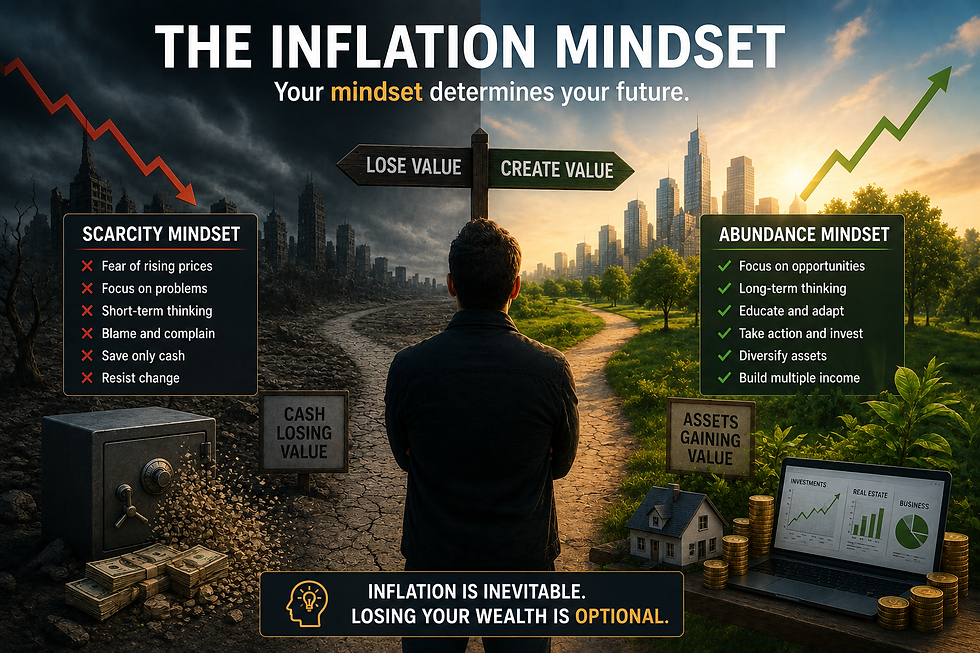
When inflation accelerates, most people immediately focus on what they are losing.
"My groceries are more expensive."
"My rent has increased."
"My savings don't go as far as they used to."
These concerns are real, and they should not be dismissed. Inflation places genuine pressure on household budgets, especially when wages fail to keep pace with rising prices.
However, financially successful people often ask a different set of questions.
Instead of asking,
"Why is everything becoming more expensive?"
they ask,
"Which assets are becoming more valuable?"
Instead of asking,
"How do I spend less?"
they ask,
"How do I earn more?"
Instead of asking,
"How can I protect my cash?"
they ask,
"How can I protect my purchasing power?"
At first, these questions may appear similar.
In reality, they lead to completely different decisions.
This difference reflects one of the most important principles of wealth creation.
Most people think primarily as consumers.
Wealth builders learn to think as owners.
Consumers naturally see inflation through the prices they pay.
Owners also notice rising prices, but they immediately begin evaluating how those price increases affect businesses, investments, rental income, and productive assets.
When a restaurant raises its menu prices, most customers complain.
The restaurant owner calculates margins.
When property prices increase, tenants often worry about higher rent.
The property owner evaluates long-term value and cash flow.
When the stock market becomes volatile because of inflation, many inexperienced investors panic.
Experienced investors ask whether high-quality businesses are temporarily selling below their intrinsic value.
The event is the same.
The perspective is different.
This mindset does not develop overnight.
It is built through continuous learning.
Financial education teaches people to look beyond headlines and understand the mechanisms driving the economy.
Instead of reacting emotionally to every economic announcement, they begin asking deeper questions.
Why are interest rates changing?
Which industries benefit from inflation?
Which businesses have pricing power?
How will this affect long-term investment opportunities?
This curiosity gradually replaces fear with understanding.
Another characteristic of the inflation mindset is the ability to distinguish between price and value.
Inflation increases prices.
It does not automatically increase value.
A luxury item may cost more simply because inflation has pushed production costs higher.
That does not necessarily make it a better product.
Likewise, a productive business may become temporarily cheaper in the stock market because investors are fearful.
Its market price declines.
Its long-term value may not.
Understanding this distinction helps investors avoid one of the most common mistakes during inflationary periods: making decisions based solely on emotions.
Fear encourages people to hold more cash just as inflation quietly reduces its purchasing power.
Optimism without discipline encourages reckless investing.
The inflation mindset avoids both extremes.
It favors rational analysis over emotional reaction.
Patience over panic.
Ownership over consumption.
Long-term thinking over short-term headlines.
Perhaps the greatest lesson inflation teaches is this:
Money itself is rarely the ultimate goal.
Purchasing power is.
A growing bank balance means very little if it buys less every year.
True financial progress is measured not by how many dollars, euros, or pounds you accumulate, but by your ability to maintain and increase your real standard of living over time.
This is why financially educated people spend less time asking,
"How much money do I have?"
and much more time asking,
"What do I own that will continue creating value regardless of inflation?"
That single question transforms the way people save, invest, and build wealth.
Because in the end, inflation rewards neither optimism nor pessimism.
It rewards preparation.
And preparation begins with the right mindset.
Chapter 9 — How to Think Like an Investor During Inflation
Inflation changes the economic environment.
It changes prices.
It changes interest rates.
It changes consumer behavior.
It even changes the way businesses operate.
But there is one thing it does not change.
The fundamental principles of intelligent investing.
Successful investors do not build wealth by trying to predict every inflation report or every central bank decision. Instead, they focus on owning productive assets, managing risk, and making rational decisions over long periods.
That approach becomes even more valuable during inflationary times.
So, how should an investor think when prices are rising?
The first principle is simple:
Think in terms of purchasing power, not just money.
Many people celebrate seeing more money in their bank account. Investors ask a different question:
"Can this money buy more than it could last year?"
A growing account balance means very little if inflation is growing even faster.
Real wealth is measured by purchasing power, not by the number displayed on a bank statement.
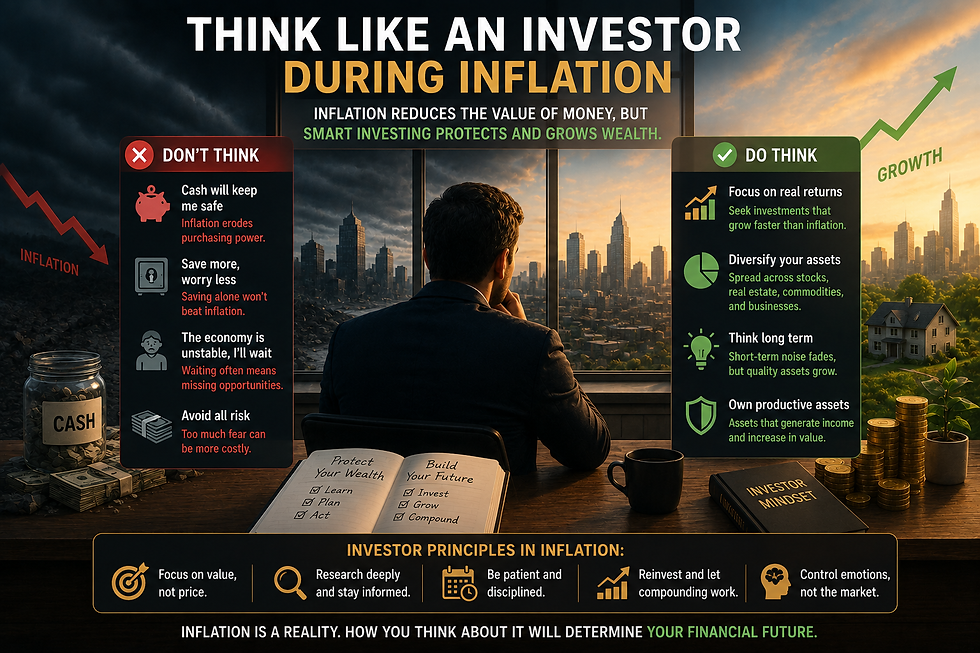
The second principle is to focus on productive assets.
Businesses, diversified stock portfolios, real estate, intellectual property, and other income-generating assets have historically offered better long-term protection against inflation than large amounts of idle cash.
This does not mean every investment succeeds.
Markets fluctuate.
Businesses fail.
Property values sometimes decline.
However, productive assets have one important characteristic that cash does not.
They can create new value.
That ability makes all the difference over decades.
The third principle is to understand the difference between investing and speculating.
Inflation often creates uncertainty.
During uncertain periods, many people begin chasing quick profits, fashionable investments, or sensational headlines.
Experienced investors usually do the opposite.
They become even more disciplined.
They rely on research rather than excitement.
They evaluate businesses instead of rumors.
They focus on long-term fundamentals instead of short-term market noise.
The fourth principle is diversification.
No single investment performs well under every economic condition.
Different assets respond differently to inflation, interest rates, economic growth, and market sentiment.
A diversified portfolio helps reduce the impact of unexpected events.
Diversification does not eliminate risk.
It manages risk.
One successful investment should never determine your entire financial future.
The fifth principle is continuous learning.
Inflation reminds us that economies constantly evolve.
New industries emerge.
Technology transforms business models.
Consumer preferences change.
Governments introduce new policies.
The investors who continue learning are often the ones best prepared to recognize opportunities before they become obvious.
Financial education is therefore not an expense.
It is an investment in better decision-making.
The sixth principle is maintaining liquidity.
Earlier in this article, we discussed why holding excessive cash can reduce purchasing power over time.
That does not mean investors should eliminate cash entirely.
Cash serves an essential purpose.
It provides flexibility.
It allows investors to respond to emergencies without selling long-term investments at unfavorable prices.
It also creates opportunities.
During periods of economic uncertainty, quality assets occasionally become temporarily undervalued.
Investors with available cash are often in a stronger position to act when others are forced to sell.
The goal is balance.
Enough liquidity to remain flexible.
Enough productive assets to protect long-term purchasing power.
The seventh principle is patience.
Inflation creates uncertainty.
Uncertainty creates volatility.
Volatility often creates fear.
Fear encourages emotional decisions.
Yet history repeatedly shows that patient investors tend to outperform those who constantly react to every market movement.
Compounding requires time.
Businesses need time to grow.
Real estate often requires years to appreciate.
Dividend-paying companies distribute wealth gradually.
Successful investing is rarely about finding the perfect opportunity.
It is usually about giving good opportunities enough time to mature.
Finally, investors understand one essential truth.
Inflation itself is neither an enemy nor a friend.
It is an economic condition.
What determines the outcome is not inflation alone.
It is how people respond to it.
Some react with fear.
Others react with preparation.
Some focus exclusively on rising prices.
Others focus on rising value.
This difference in perspective influences nearly every financial decision.
Should you continue learning new skills that increase your earning potential?
Should you invest regularly instead of trying to perfectly time the market?
Should you build assets that generate income rather than relying solely on your salary?
These are the questions investors ask.
Because they understand something that most people discover only much later.
The greatest investment is rarely the one with the highest return.
It is the one that continuously increases your ability to make better financial decisions.
That is why the most valuable asset you will ever own may not be your house.
Or your investment portfolio.
Or even your business.
It may be your financial knowledge.
Assets can be lost.
Markets can fall.
Businesses can fail.
But the ability to understand how wealth is created, protected, and multiplied stays with you for life.
And once you acquire that knowledge, inflation no longer becomes something you simply fear.
It becomes something you understand.
And understanding almost always leads to better decisions.
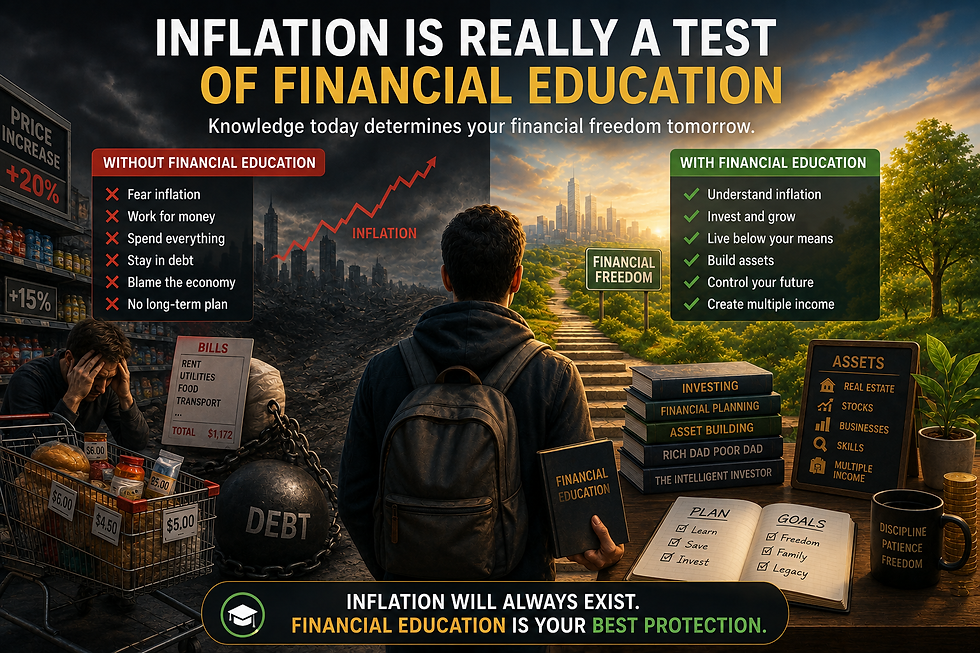
Chapter 10 — Inflation Is Really a Test of Financial Education
Imagine two families living in the same city.
Both earn approximately the same household income.
Both have stable jobs.
Both experience the same inflation rate.
Both shop at the same supermarkets.
Both pay more for fuel, housing, healthcare, and everyday necessities.
From the outside, their financial situations appear almost identical.
Yet ten years later, one family has built considerable wealth.
The other is struggling to keep up with the rising cost of living.
What happened?
The answer is not luck.
It is not intelligence.
And it is certainly not inflation itself.
The difference lies in the financial decisions they made while living through the exact same economic environment.
The first family viewed inflation as an unavoidable burden.
Every increase in prices felt like a loss.
Whenever they managed to save money, they left it sitting in a bank account because it felt safe.
As prices continued to rise, they gradually reduced their savings to maintain their lifestyle.
When interest rates changed, they reacted emotionally.
When markets declined, they became fearful.
When headlines predicted uncertainty, they postponed investing.
Their financial decisions were driven primarily by short-term comfort and immediate certainty.
The second family experienced the same inflation.
They also noticed higher grocery bills.
Higher utility costs.
Higher insurance premiums.
Nothing about their daily lives was easier.
But they approached the situation differently.
Instead of asking,
"How do we survive inflation?"
they asked,
"How do we adapt to it?"
They built an emergency fund to protect themselves against unexpected events.
They invested regularly instead of waiting for the "perfect" moment.
They increased their financial education every year.
They gradually acquired productive assets.
Some invested in diversified stock portfolios.
Others purchased rental properties when it suited their circumstances.
Some built businesses.
Others developed valuable professional skills that allowed them to negotiate higher incomes over time.
Their objective was never to predict inflation.
Their objective was to become more resilient regardless of what inflation did next.
Over the years, small decisions began producing remarkable differences.
One family spent years trying to preserve yesterday's purchasing power.
The other spent years building tomorrow's earning power.
One focused almost entirely on saving money.
The other focused on creating assets.
One reacted.
The other prepared.
Neither family controlled inflation.
But one family learned to control its response to inflation.
That is one of the most important lessons in personal finance.
Economic conditions affect everyone.
Financial education determines how people respond to those conditions.
This explains why inflation often widens existing wealth gaps.
It is not because inflation chooses winners and losers.
It is because knowledge influences decisions, and decisions shape long-term outcomes.
Financial education changes the questions people ask.
Instead of asking,
"When will inflation end?"
they begin asking,
"Which financial habits remain valuable in every economic environment?"
Instead of wondering,
"How much cash should I accumulate?"
they ask,
"Which assets can continue creating value over the next twenty years?"
Instead of fearing every economic headline, they seek to understand the forces behind it.
This shift in thinking rarely produces dramatic results overnight.
It works quietly.
Almost invisibly.
Just like compound interest.
Just like inflation itself.
Small improvements in financial knowledge accumulate year after year.
Better decisions lead to better opportunities.
Better opportunities generate stronger financial foundations.
Eventually, what once appeared to be luck begins to look like preparation.
This is why inflation should not only be viewed as an economic event.
It is also a test.
A test of patience.
A test of discipline.
A test of emotional control.
And above all, a test of financial education.
Because inflation does not ask how much money you earn.
It quietly asks a more important question.
Do you understand how money works?
The answer to that question will often matter far more than the inflation rate itself.
In the end, inflation is not simply changing prices.
It is revealing habits.
It exposes whether we think like consumers or owners, whether we react emotionally or strategically, and whether we prepare for the future or merely respond to the present.
That is why the greatest protection against inflation is not a single investment, a perfect market prediction, or even a higher salary.
It is the ability to understand the economic forces shaping your financial life—and to make decisions that allow your wealth to grow despite them.
Inflation is temporary.
Financial knowledge can last a lifetime.
And over the long run, that knowledge may become the most valuable asset you ever own.
Frequently Asked Questions (FAQ)
1. Is inflation always bad?
Not necessarily. Moderate inflation is generally considered a normal part of a growing economy. It often reflects increasing demand, rising wages, and expanding business activity. Problems arise when inflation becomes too high or unpredictable, reducing purchasing power and making financial planning more difficult. The key issue is not whether inflation exists, but whether incomes, productivity, and investments can keep pace with rising prices over the long term.
2. Why do wealthy people often benefit more from inflation?
Many wealthy individuals own productive assets such as businesses, stocks, real estate, or intellectual property. These assets often have the potential to increase in value or generate higher income as prices rise. By contrast, people who rely mainly on salaries and large cash savings may see their purchasing power decline if their income does not keep pace with inflation. Ownership, rather than income alone, often explains the difference.
3. Should I keep cash during periods of inflation?
Yes—but in moderation. Cash remains essential for emergency expenses, short-term needs, and financial flexibility. However, holding excessive amounts of cash over many years may reduce your purchasing power if inflation consistently exceeds the interest earned on your savings. A balanced financial strategy usually combines adequate liquidity with long-term investments that have the potential to preserve or increase purchasing power over time.
4. Which assets have historically performed well during inflation?
No investment guarantees protection against inflation, and past performance never guarantees future results. However, productive businesses, diversified stock portfolios, certain real estate investments, and some commodities have historically shown greater resilience than idle cash over long periods. The most appropriate investment depends on your financial objectives, risk tolerance, investment horizon, and overall portfolio diversification.
5. Can inflation actually help reduce debt?
In some situations, yes. If you have a long-term, fixed-rate loan, inflation may reduce the real value of your future repayments because you repay the debt with money that has lower purchasing power than when you borrowed it. However, this does not make debt automatically beneficial. The borrowed money should ideally finance productive assets or activities capable of creating long-term value, not unnecessary consumption.
6. What is the best protection against inflation?
There is no single solution that works for everyone. The strongest long-term protection usually comes from combining financial education, continuous skill development, diversified productive assets, disciplined investing, and thoughtful risk management. Inflation is an economic reality that cannot always be controlled, but your financial habits, investment decisions, and willingness to keep learning can significantly influence how it affects your long-term financial future.
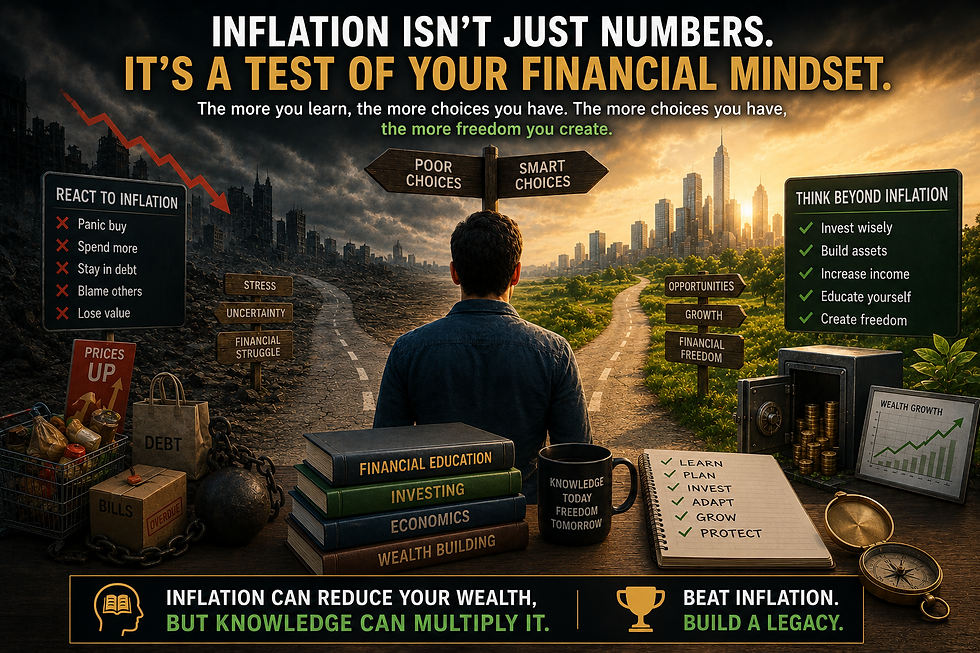
Conclusion
Inflation is one of the few economic forces that affects almost everyone.
It influences workers and business owners.
Savers and investors.
Governments and central banks.
Young families trying to buy their first home and retirees living on fixed incomes.
No one is completely immune.
Yet one of the biggest lessons from this article is that inflation does not affect everyone in the same way.
For some, it quietly reduces purchasing power year after year.
For others, it creates opportunities to grow businesses, increase the value of productive assets, and build long-term wealth.
The difference is rarely a matter of luck.
More often, it is a matter of understanding.
People who view money only as something to earn and spend naturally experience inflation as a rising cost of living.
Those who understand ownership, investing, and value creation often see the same environment through a very different lens.
They recognize that while cash may lose purchasing power, productive assets have the potential to continue creating value.
They understand that debt can either finance consumption or accelerate wealth creation, depending on how it is used.
They know that businesses with strong pricing power often adapt better to inflation than those competing only on low prices.
Most importantly, they understand that successful investing is not about predicting the future perfectly.
It is about preparing for different possible futures.
Inflation reminds us that money itself is never the ultimate objective.
Purchasing power is.
A growing bank balance means little if it buys less every year.
True wealth is not measured by the number of zeros in an account.
It is measured by your ability to maintain and improve your quality of life over decades.
That ability comes from developing valuable skills, making informed financial decisions, owning productive assets, and continuously investing in your knowledge.
Perhaps the greatest mistake people make is believing that inflation is something happening to them.
In reality, inflation is an economic environment.
Like every environment, it rewards certain behaviors and penalizes others.
The good news is that behaviors can change.
Knowledge can be acquired.
Habits can improve.
Financial decisions can become wiser over time.
You do not need to control inflation to improve your financial future.
You only need to understand how inflation works and position yourself accordingly.
That is the real advantage of financial education.
It transforms uncertainty into understanding.
It replaces fear with preparation.
And it helps you recognize opportunities where others see only obstacles.
The wealthy do not necessarily succeed because inflation exists.
They often succeed because they understand how money, assets, incentives, and long-term value interact within an inflationary world.
That knowledge is available to anyone willing to learn.
The question is no longer whether inflation will continue.
History suggests that periods of inflation will always return.

The more important question is this:
When the next wave of inflation arrives, will you simply watch your purchasing power decline... or will you own the knowledge and the assets that allow your wealth to grow despite it?
Because inflation changes prices.
Financial education changes lives.



Comments